It´s one of the best comedores in town, but I just couldn´t get excited about my scrambled eggs, rice, and tomato salad last night at Lizzette´s. I picked at my plate with all the enthusiasm of someone who heard their dog just died. Staring out the window onto the narrow street where college students scurried to and fro, I remarked to my companions that what I could really go for was a chicken quesadilla, some chips and salsa, and a little cafe after dinner. (BTW, I wish breakfast tacos were non-perishable, so someone could send me some chilaquiles). As I sippled my limonada, I reminisced for a minute about my favorite dinner memories in Texas, most of which involved a homecooked meal around a table with cherished friends...and a leisurely cup of coffee to top it off.
Believe it or not, as good as the coffee beans are here, it´s rare to find anything but the instant variety in the restaurants around Leon. So I invested in a small pot, which I have used to implement a new coffee-making technique involving boiling water, coffee grounds, and a strainer. While I have periodic access to the kitchen in my boarding house, not having a kitchen of my own has been a harder thing than I thought to adjust to over the last few weeks. While it´s possible to eat a meal for under $1 here, it wears a little on me not to have my own refrigerator, and to only buy what I will eat in the next 24-48 hours at the store (including non-perishable items). If you keep anything (especially something sweet) around longer than 2 days, it´s a fairly good possibility that the ants will find it, even in a sealed container. (I keep my sugar and bread on the highest shelf from the floor, which so far has been successful, but with the rain coming more frequently these days, who knows.)
O Dios, make me grateful for the food I have, the resources that make its purchase possible, and the Pan de Vida that sustains me in all things. Amen.
Thursday, May 25, 2006


Tuesday, May 23, 2006
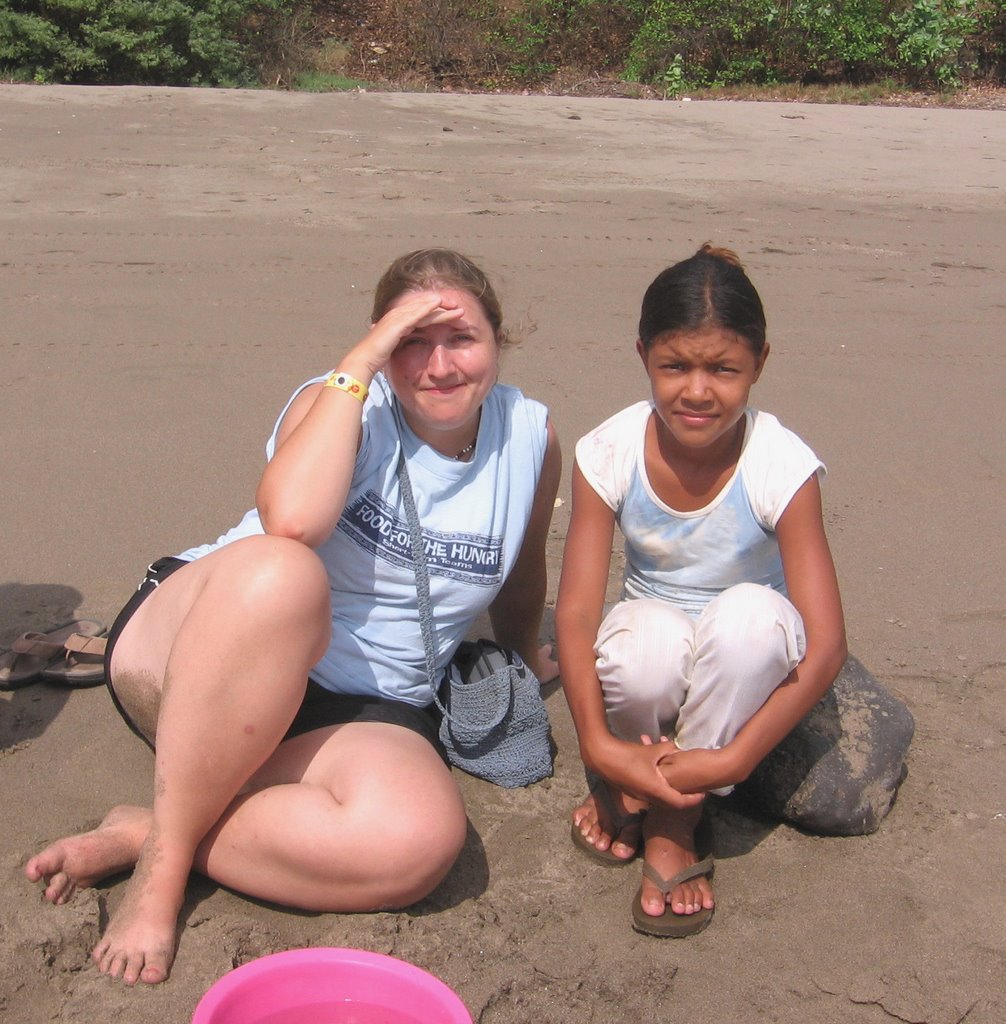
“I wondered how the poverty, the lack of good food and good housing would affect me; I was afraid of becoming depressed by the misery I would see. But God showed me something else first: affectionate, open, and playful children who are telling me about love and life in ways no book was ever able to do. I now realize that only when I can enter with the children into their joy will I be able to enter also with them into their poverty and pain. God obviously wants me to walk into the world of suffering with a little child on each hand.” -Henri Nouwen, Gracias
Interspersed between language learning and cultural adjustment, the most significant moments of my time thus far in Nicaragua have involved children. The students in San Geronimo who crowded around me during a visit one day asking me word after word in English, offering me treats, and eager for hugs. The little children in San Ramon, a tiny community outside Leon I visited last week with a neighbor. Despite dirty faces and matted hair, these children greeted me with smiles and kisses. Their meager circumstances did not prevent them from proudly introducing us to their perro, and her 6 perritos. The simple joy with which they played in the dirt and loved on their pets left me humbled and speechless. When have I ever been able to forget what I didn't have and live in the moment?
And then of course there is Majurie.
While walking along the beach with some friends, we saw a Nica girl selling jewelry and trinkets. I wasn't planning on buying anything, but our negative responses did not deter her. Even after we refused her, she continued to walk alongside us until I started talking to her. Marjurie is 11 years old—she had long dark hair, and wore a light t-shirt and white cotton pants that she had rolled up to keep them from touching the sand. She told me her favorite subject in school is math and that she lives with her mother and sister and brother in town—and that her dad had already died. With a smile that could light up the darkest room, she told us stories of how whales washed up on the beach and were eaten by snakes, and how she likes to swim.
Finally I stopped and took another look at her bowl and decided to buy a necklace. I thought that was going to be the end of it, but even after the transaction, Majurie continued to walk with us. Eventually my friends and I stopped and sat down, and Majurie sat down with us. As we talked in English, Majurie watched us with great amusement, and began playing in the sand. First she drew creations in the semi-wet sand, then began to dig a hole in which she buried my friend Kathy's feet. After a while all of us were covered in sand, but before we could walk down to the water, Majurie emptied out her pink bowl of trinkets and ran down to fill it with ocean water. When she brought it back, she offered it to us to clean off our hands, and when none of us seemed capable of successfully removing the sand completely, she did it for us.
How often in my life have I treated relationships like transactions? How often in my life have I chosen a task over a friend? When have I served for the simply joy of being with the one whom I am serving? How many opportunities have I missed learning from someone because I assumed they had nothing to teach me? When did I give with no expectation in return?
“And a little child will lead them...”
Sunday, May 21, 2006
noticias politicas
From the NY Times:
"In Nicaragua, Mr. Chávez has thrown his support behind Daniel Ortega, the former leader of the communist Sandinista revolution, who is running for president in November elections.
"I shouldn't say I hope you win because they will accuse me of sticking my nose into Nicaraguan internal affairs," Mr. Chávez told Mr. Ortega, who was invited on his radio show in late April. "But I hope you win."
Mr. Chávez pledged to supply cheap fuel to a group of Sandinista-run towns. The gesture was interpreted by opponents as a naked ploy to influence the vote and criticized as a backhanded way to funnel money to the Ortega campaign. Nicaragua's government called on Mr. Chávez to stay out. "We hope this partisan support comes to an end so that Nicaraguans can freely choose who we want to be the next leader of Nicaragua," Foreign Minister Norman Caldera told Nicaraguan television this month.
The American ambassador to Nicaragua, Paul A. Trivelli, speaking to Nicaraguan media, accused Mr. Chávez of "direct intervention," but analysts said it was too soon to say what effect Mr. Chávez would have on the vote. "
"In Nicaragua, Mr. Chávez has thrown his support behind Daniel Ortega, the former leader of the communist Sandinista revolution, who is running for president in November elections.
"I shouldn't say I hope you win because they will accuse me of sticking my nose into Nicaraguan internal affairs," Mr. Chávez told Mr. Ortega, who was invited on his radio show in late April. "But I hope you win."
Mr. Chávez pledged to supply cheap fuel to a group of Sandinista-run towns. The gesture was interpreted by opponents as a naked ploy to influence the vote and criticized as a backhanded way to funnel money to the Ortega campaign. Nicaragua's government called on Mr. Chávez to stay out. "We hope this partisan support comes to an end so that Nicaraguans can freely choose who we want to be the next leader of Nicaragua," Foreign Minister Norman Caldera told Nicaraguan television this month.
The American ambassador to Nicaragua, Paul A. Trivelli, speaking to Nicaraguan media, accused Mr. Chávez of "direct intervention," but analysts said it was too soon to say what effect Mr. Chávez would have on the vote. "
Wednesday, May 17, 2006
sights and sounds
Roosters crowing on my patio announce the coming of the day. Water dripping of the roof after a late night rainstorm. The constant whirring of the fan that keeps my room a bearable temperature. Early in the morning women proudly sweeping the dirt off the sidewalk in front of their homes. Children dressed in trademark white shirts and navy pleated skirts or pants atop of bicycles on their way to school. Piles of trash waiting to be picked up on the streets. Money changers standing on the banking corners waiting for customers. A blaring horn signaling the noon hour all across the city. Men drinking cerveza in the downtown cafe during lunch. Women cooking and selling food on every square inch of available sidewalk. Students selling artistic creations on the edge of Poet's Park. University students carrying Jansport backpacks. Colorful historic murals decorating cement walls. Taxis honking as they approach intersections looking for fares. Cathedral bells ringing.
sobre la iglesia
Another post for Paul (though I hope other readers find this interesting as well). I can't take credit for the insights that follow. I've selected them from one of the books I read about Nicaraguan history recently, called Nicaragua in Focus, published by Interlink. Personal comments are italicized.
“Spanish colonial authorities used religion as a means of control in Nicaragua with great success. The church colluded with colonial authorities for many years, preaching subservience to its native congregations. Church leaders were extremely wealthy and supportive of the conservative ruling class, a reality that is still present today.
The Catholic Church in Nicaragua has rarely spoken out against the status quo. Only in the late 1970s did bishops here join the ranks of the anti-Somoza movement. However, lower classes of catholics actively participated in the Sandinista revolution under the influence of liberation theology doctrine. The most radical parallel might go something like this—Sandino was Jesus or Moses, Somoza was Pharaoh, and the masses like the Israelites. Priests and nuns were vital in the urban insurrection, acting as messengers and providing shelter for guerrillas. Many clergy members were given positions in the new FSLN government.
Pope John Paul II condemned the activity of these clergy as contradictory to the Gospel when he visited Nicaragua in 1983. When the Sandinistas were defeated in 1990, a conservative bishop was appointed to the region, who openly supported the Liberal Alliance (kind of a misnomer, as they represent a conservative political faction here in Nicaragua). The Catholic influence in Nicaragua today is largely symbolic, and limited to major festivals and celebrations.(Schools here close for the entire Holy Week in the spring, and for “summer break” in December and January, during which there are several religious observances that attract a large number of Nicas.)
Meanwhile, the Protestant influence began to greatly expand in the 1950s and 60s, especially Baptist, Episcopalian, and Assembly of God denominations. (There are 9 Assembly of God churches in Leon alone.) Much of the leadership of these churches is now Nicaraguan, due in part to the pro-Somoza North American Christians who fled the country during the Sandinista revolution. Today about 1/3 of the country belongs to some Protestant church.”
[One more note about the Catholics. There was an article Monday in La Prensa, one of the national Nicaraguan daily papers here, about the soon-to-be-released Da Vinci Code movie. The local Nicaraguan bishop was quoted as supporting Catholics who might want to see the film (with a critical eye of course), while the Salvadorian bishop condemned the film and urged his congregations not to see it at all. An interesting contrast in Catholic leadership. ]
“Spanish colonial authorities used religion as a means of control in Nicaragua with great success. The church colluded with colonial authorities for many years, preaching subservience to its native congregations. Church leaders were extremely wealthy and supportive of the conservative ruling class, a reality that is still present today.
The Catholic Church in Nicaragua has rarely spoken out against the status quo. Only in the late 1970s did bishops here join the ranks of the anti-Somoza movement. However, lower classes of catholics actively participated in the Sandinista revolution under the influence of liberation theology doctrine. The most radical parallel might go something like this—Sandino was Jesus or Moses, Somoza was Pharaoh, and the masses like the Israelites. Priests and nuns were vital in the urban insurrection, acting as messengers and providing shelter for guerrillas. Many clergy members were given positions in the new FSLN government.
Pope John Paul II condemned the activity of these clergy as contradictory to the Gospel when he visited Nicaragua in 1983. When the Sandinistas were defeated in 1990, a conservative bishop was appointed to the region, who openly supported the Liberal Alliance (kind of a misnomer, as they represent a conservative political faction here in Nicaragua). The Catholic influence in Nicaragua today is largely symbolic, and limited to major festivals and celebrations.(Schools here close for the entire Holy Week in the spring, and for “summer break” in December and January, during which there are several religious observances that attract a large number of Nicas.)
Meanwhile, the Protestant influence began to greatly expand in the 1950s and 60s, especially Baptist, Episcopalian, and Assembly of God denominations. (There are 9 Assembly of God churches in Leon alone.) Much of the leadership of these churches is now Nicaraguan, due in part to the pro-Somoza North American Christians who fled the country during the Sandinista revolution. Today about 1/3 of the country belongs to some Protestant church.”
[One more note about the Catholics. There was an article Monday in La Prensa, one of the national Nicaraguan daily papers here, about the soon-to-be-released Da Vinci Code movie. The local Nicaraguan bishop was quoted as supporting Catholics who might want to see the film (with a critical eye of course), while the Salvadorian bishop condemned the film and urged his congregations not to see it at all. An interesting contrast in Catholic leadership. ]
Tuesday, May 16, 2006
some random reflections
The trip out of the city is always a learning experience in any culture. Here in Nicaragua, the road to Poneloya was on the rough side, cattle crossings a common sight, and bumps a frequent part of the ride. The terrain was fairly green for a while, but there are some semi-arid areas along the way, much less inhabited. From one side you can see volcanoes off in the distance, and from the other side you can see poorer Nicaraguans who live out in the campo making a subsistence living while making their homes in shacks the same size as my room in Leon.
Leaving town last Friday in a bus, I felt much like the many Nicaraguans who rely on public transportation to get where they need to go—I felt much less common ground on the way home when a new friend (Orlando) and his son (Raymond) took me, Anne, and Heather home in an air-conditioned sedan. The contrast between our comfortable method of transportation and the many people we passed standing in the heat on the side of the road or riding bicycles was palpable. I was grateful for the less time-consuming process of getting home, but the whole weekend is a microcosm of the tension I have been feeling between my “rich american” identity and my desire to live like the majority of people here, simply and without so many of the amenities that most people here do without...
The western influence here is everywhere—from the clothes the college students wear, to the things you can find in the market, to the music I hear in the restaurants and buses here. American brands—clothing, food, toiletries, bands—are inescapable in the city. I was surprised (but should not have been, I suppose, given all of this) that my new friend Orlando's son Raymond's favorite music was Journey and U2, which we listened to on the car ride home Sunday evening.
I have noticed that there is a distinct difference in how I am treated when I dress like a tourist (think shorts and a tank top) versus an “expat native” (think capris/jeans, and a collared shirt). When I greet people, they are more apt to talk me if I look like I belong here, and the vendors on the street are more likely to ignore me than when I look like a visitor who doesn't know anything.
Two things I am having a hard time adjusting to are being tired all the time (they say it takes a while to get used to the constant heat), and being bitten by various bugs. It doesn't matter if I wear bugspray or not, by the end of the night, I am guaranteed a new abrasion somewhere on my body. When the rainy season starts, everyone uses mosquito nets, which I hope will be effective, as I can only imagine what happens when the moisture level here rises.
While we were at the beach Saturday, we took a long walk down the waterfront that eventually led to some rocks which we promptly climbed. It was well worth the sore feet we suffered, as from the top we could see another sturdy rock with a cross perched on its surface, while wave after wave crashed against it. The whole scene reminded me of the parable Jesus tells in the Gospels of the man who builds his house on the rock, that was battered by the storm but could not be destroyed because of its firm foundation. Lord, may that same foundation continue to gird me here, as tiny frustrations mount and tears come too easily. Thank you for my Spanish teacher and Nicaraguan friend Lorena who encouraged me today when mis emociones flooded mis ojos in the middle of our simple conversacion.
Por favor, ayudame, Senor. Quiero tener esperanza en mi corazon en cualquier lugar donde yo estoy. Poco a poco, yo se que estoy creciendo y Tu eres conmigo siempre. En el nombre de Cristo. Amen.
Leaving town last Friday in a bus, I felt much like the many Nicaraguans who rely on public transportation to get where they need to go—I felt much less common ground on the way home when a new friend (Orlando) and his son (Raymond) took me, Anne, and Heather home in an air-conditioned sedan. The contrast between our comfortable method of transportation and the many people we passed standing in the heat on the side of the road or riding bicycles was palpable. I was grateful for the less time-consuming process of getting home, but the whole weekend is a microcosm of the tension I have been feeling between my “rich american” identity and my desire to live like the majority of people here, simply and without so many of the amenities that most people here do without...
The western influence here is everywhere—from the clothes the college students wear, to the things you can find in the market, to the music I hear in the restaurants and buses here. American brands—clothing, food, toiletries, bands—are inescapable in the city. I was surprised (but should not have been, I suppose, given all of this) that my new friend Orlando's son Raymond's favorite music was Journey and U2, which we listened to on the car ride home Sunday evening.
I have noticed that there is a distinct difference in how I am treated when I dress like a tourist (think shorts and a tank top) versus an “expat native” (think capris/jeans, and a collared shirt). When I greet people, they are more apt to talk me if I look like I belong here, and the vendors on the street are more likely to ignore me than when I look like a visitor who doesn't know anything.
Two things I am having a hard time adjusting to are being tired all the time (they say it takes a while to get used to the constant heat), and being bitten by various bugs. It doesn't matter if I wear bugspray or not, by the end of the night, I am guaranteed a new abrasion somewhere on my body. When the rainy season starts, everyone uses mosquito nets, which I hope will be effective, as I can only imagine what happens when the moisture level here rises.
While we were at the beach Saturday, we took a long walk down the waterfront that eventually led to some rocks which we promptly climbed. It was well worth the sore feet we suffered, as from the top we could see another sturdy rock with a cross perched on its surface, while wave after wave crashed against it. The whole scene reminded me of the parable Jesus tells in the Gospels of the man who builds his house on the rock, that was battered by the storm but could not be destroyed because of its firm foundation. Lord, may that same foundation continue to gird me here, as tiny frustrations mount and tears come too easily. Thank you for my Spanish teacher and Nicaraguan friend Lorena who encouraged me today when mis emociones flooded mis ojos in the middle of our simple conversacion.
Por favor, ayudame, Senor. Quiero tener esperanza en mi corazon en cualquier lugar donde yo estoy. Poco a poco, yo se que estoy creciendo y Tu eres conmigo siempre. En el nombre de Cristo. Amen.
Monday, May 15, 2006
nuevas amigas
Since I talk so much about them, I thought you should meet my new friends and fellow FHI staff in Leon. Anne is on the left; Heather is on the right.


Ponelona Sunset
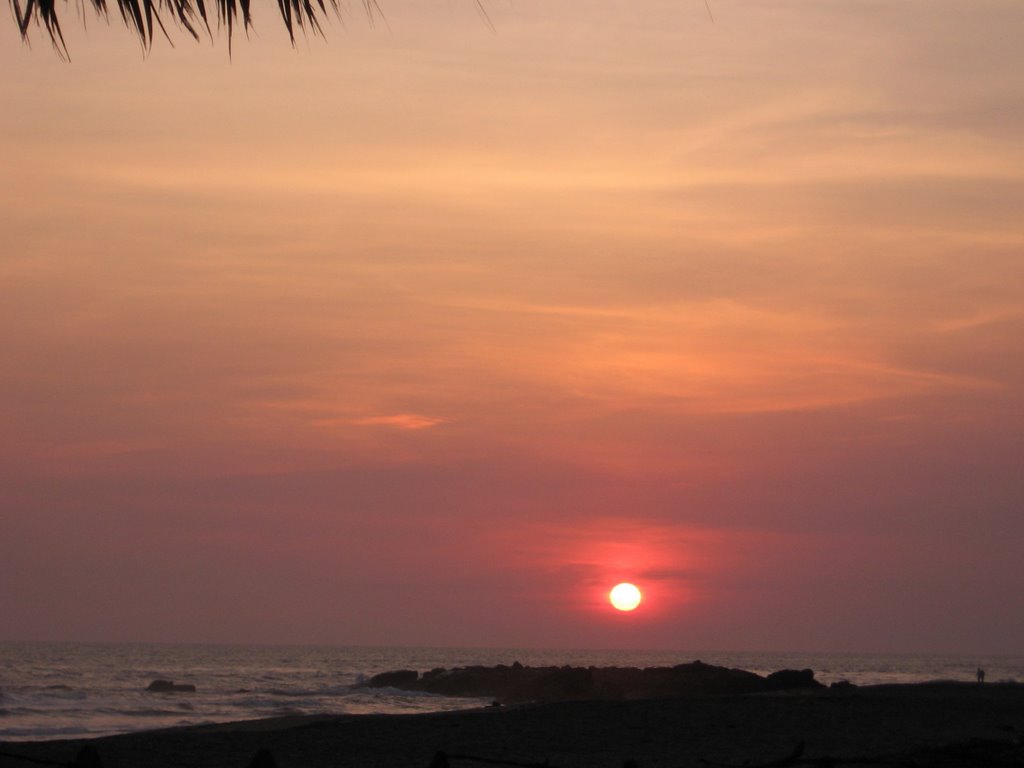 For less than $1USD and in a little over 90 minutes, I traveled this weekend to the coastal village of Ponelona to enjoy la playa with my new friends Anne and Heather. This was the sunset Friday night.
a little historia politica

At the request of my friend Paul, here is a (somewhat) brief synopsis of the events leading to the Sandinista Revolution here in Nicaragua and a little of what has transpired since.
The story begins when a young Nica man named Augusto Cesar Sandino witnesses the US invasion of Nicaragua to sustain a failing Conservative government here by brutally crushing the Liberal rebellion. After spending a few years in Mexico, Sandino is inspired by the unionization efforts of workers there. He returns to Nicaragua and becomes a general for the Liberals, engaging in guerrilla warfare against the US installations in northern Nicaragua. In addition to his warfare strategies, Sandino formed agricultural coops of landless peasants, and fought on behalf of exploited workers. Finally the U.S. Marines left around the time of the Great Depression and Anastasio Somoza Garcia became president of Nicaragua. Somoza ordered Sandino shot, but Sandino's body was never found.
The installation of Somoza began a long and powerful family dynasty, under which power was centralized in the hands of a very few, elections were shams, and financial gain was limited to those within the dynasty. Somoza Garcia was well educated and has a successful relationship with U.S. Presidents, creating a lucrative trade relationship with the US at the expense of local natural resources and sustainable economic development. Somoza is remembered for several positive developments in Nicaragua too, including the construction of some public buildings, a railway, city water system, the airport, and the Pan-American Highway. Members of Somoza's family remained in power from 1937-1979.
In the 1960s, a student named Carlos Fonseca Amador revived the Sandino image and ideals to inspire a new political and guerilla movement which became known as the F.S.L.N. (Frente Sandinista de Liberacion Nacional). FSLN was initially supported by college students and city dwellers, but soon earned the loyalties of poor campesinos, and by 1979, had developed enough military strength to overthrow the dictatorship. After winning the war, FSLN had the tougher job of reorganizing the government and economy, a process which included the redistribution of thousands of acres of land and a massive literacy campaign, among other things.
From the beginning, FSLN encountered opposition, internally from the business community and externally from the world powers who were concerned about the Marxist tendencies of the new regime.The US began financing the Contras, former members of the Somoza national guard as well as campesinos unhappy with the FSLN's policies. By the end of the 1980s, the Sandinista government and the Contra war collapsed, and a Central American peace accord was reached. The agreement included pledges from all countries to permit full freedom for political parties and periodic elections (externally monitored).
For the last 15 years, while strongly contesting many elections as a legitimate political party, the Sandinistas have remained unable to retake the presidency, as members of other parties and coalitions have managed to defeat repeat FSLN candidate Daniel Ortega. Since the revolution, a “reformed Sandinista” party has also formed, known locally as MRS. MRS, FLSN, and two different Liberal coalitions have formed to vie for the presidency this year. It remains to be seen how the elections this November will turn out.
Thursday, May 11, 2006
after 7 days...
Well, it's been a week. Still so much I have to learn about this city (never mind the country), this culture, the language. That is the overwhelming feeling I left yesterday with. I am a learner and that is just all there is to it. When Lorena (my Spanish tutor) and I were meeting yesterday and talking about the 3 perfect tenses, I became a little frustrated with myself because I didn't already know some of the things she asked me.
Yes, I admit it. I was frustrated. I think I was also tired because I almost started crying in the middle of my lesson. A totally disproportionate response to the realities of learning, I know. And on top of that, I know that the more I think I know, the more I will simultaneously realize how much more I don't know at all.
I was also frustrated today by the quest to find the supermercado La Union. I was down in the tourist area buying a map and some postcards and then it took me almost 45 minutes to go 4 blocks, because I found myself going in circles and unable to decipher the map I was given. It doesn't help that none of the streets here are really marked except for Avenida Central, the street that goes right through town to the central mercado and Cathedral. The same thing happened yesterday when I embarked on the seemingly simple task of finding the post office that Heather had told me was on the same street as a restaurant we had eaten at the night before. Of course I did not remember any of the landmarks on this street until I had gone about 10 blocks out of my way and backtracked in several different directions. And even then I could not find it on my own but had to ask several people how to get where I wanted to go. Some good things came out of my prolonged search for the post office, though. I wound up in the university district which was an area I had not seen yet, and I discovered a used bookstore where I bought a book of Nicaraguan folklore (in Spanish of course) which looks really good.
So I have a lot to learn. And to help with that, my other new friend Anne has been graciously lending me book after book. The latest ones are on the geography of the country and a memoir of the Sandinista revolution written by a well-respected local author. I also have several books on Spanish grammar, in which I desperately want to improve, but am finding to be a mentally draining and emotionally involved process. So, as I drifted off to sleep last night, I found myself yearning to see a light not only at the end (because there really is no end), but also in the midst of, this tunnel of learning. Lord, how I need Your light each and every night.
Yes, I admit it. I was frustrated. I think I was also tired because I almost started crying in the middle of my lesson. A totally disproportionate response to the realities of learning, I know. And on top of that, I know that the more I think I know, the more I will simultaneously realize how much more I don't know at all.
I was also frustrated today by the quest to find the supermercado La Union. I was down in the tourist area buying a map and some postcards and then it took me almost 45 minutes to go 4 blocks, because I found myself going in circles and unable to decipher the map I was given. It doesn't help that none of the streets here are really marked except for Avenida Central, the street that goes right through town to the central mercado and Cathedral. The same thing happened yesterday when I embarked on the seemingly simple task of finding the post office that Heather had told me was on the same street as a restaurant we had eaten at the night before. Of course I did not remember any of the landmarks on this street until I had gone about 10 blocks out of my way and backtracked in several different directions. And even then I could not find it on my own but had to ask several people how to get where I wanted to go. Some good things came out of my prolonged search for the post office, though. I wound up in the university district which was an area I had not seen yet, and I discovered a used bookstore where I bought a book of Nicaraguan folklore (in Spanish of course) which looks really good.
So I have a lot to learn. And to help with that, my other new friend Anne has been graciously lending me book after book. The latest ones are on the geography of the country and a memoir of the Sandinista revolution written by a well-respected local author. I also have several books on Spanish grammar, in which I desperately want to improve, but am finding to be a mentally draining and emotionally involved process. So, as I drifted off to sleep last night, I found myself yearning to see a light not only at the end (because there really is no end), but also in the midst of, this tunnel of learning. Lord, how I need Your light each and every night.
Subscribe to:
Posts (Atom)

