Well, yes. At least in Managua, where the shops are already full of Christmas trees, decorations, ornaments, nativity scenes, and Santa Claus. Unlike the USA, there are no major holidays here in October and November (like Halloween or Thanksgiving) to preclude the Christmas season from starting well before you can even imagine singing the familiar carols or making a wish list.
Unless, of course, you have an Amazon wishlist like I do. Since it takes about 2 weeks to get letters and up to 8 weeks to get packages here, I thought in the spirit of the season I would share this with all of you now. Just in case you're interested. : )
After all, there are only 54 shopping days left...
Tuesday, October 31, 2006


Sunday, October 29, 2006
one of our fan's many functions
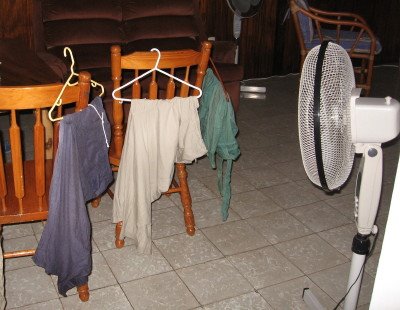
Desperate times call for desperate measures.
And this was indeed a desperate time. Down to our last day of clothing, and with no sign of the woman we normally pay to clean our clothes for the last 2 weeks, Andrea and I took matters into our own hands this afternoon (literally). Unfortunately, in the middle of the afternoon came a massive tormenta (storm) that prevented us from hanging our clean, wet clothes outside.
Thus the improvisational drying strategy you see above. Strange, I admit. But effective, as after 4 hours of fan-generated wind, these clothes are practically dry.
Only in Nicaragua...
Saturday, October 28, 2006
saturday in masaya
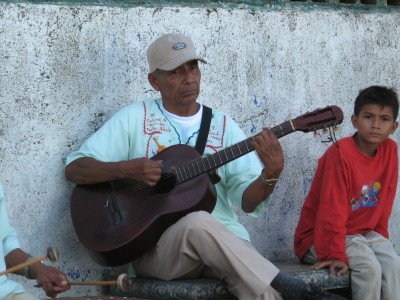
Music is alive and well in Nicaragua!
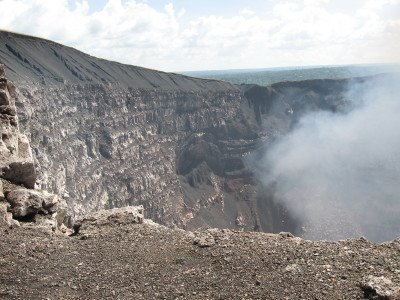 Volcan Nidiri (still smokin')
 Colorful artesania in the market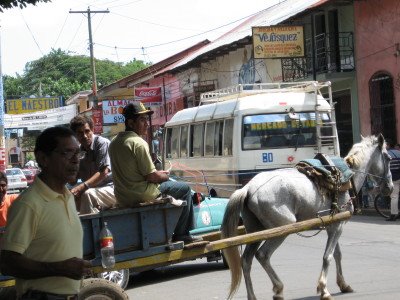
Street scene
Friday, October 27, 2006
where did this week go?
 Monday's task was patience with the never ending series of power outages that prevent most days from being more than 50% productive. I actually cannot tell you what I accomplished Monday. A totally lost day.
Tuesday's adventure involved a trip to Chinandega, where I saw the physical beginnings of a community garden in the oft-forgetten and impoverished community of El Limonal and interviewed a young, dynamic leader named Fatima for a future story in the Nehemiah Center newsletter (and also helped divide pills into bags for distribution in the community, with the help of Fatima's son--pictured left). This entire day was by far the most rewarding work-related experience of the week, for a variety of reasons I will likely elaborate on in my November newsletter.
Wednesday's daylight was spent in large part in the world of Publisher, finalizing various aspects of the Nehemiah Center's annual report, which I am producing in English and Spanish.
Thursday and Friday's agenda was filled by a taller (workshop) on effective adult education techniques, which I attended in part to learn, and in part to document via photos. The workshop was led by a Nehemiah Center training team member and participants came from communities all over the country to participate. Two highlights from Friday: my lunch conversation with a participant involved in the reformed Sandinista political organization (MRS), and presenting a "practice taller" on pottery making with a group of women, a subject I knew nothing about (but about which my fellow group members were experts). Talk about a learning experience.
And, to wrap the week up with a big happy bow, Andrea and I invited our co-worker/missionary friend Jason and his wife Jess to our house for dinner tonight, which was delightfully light-hearted and refreshing. After an intense week & many kinds of frustrations, two hours with a couple of other young, likeminded, fun Americans (and Jess' yummy chocolate cake) was just what the culture stress doctor ordered!
Monday, October 23, 2006
in esteli
 From L-R: Nathan Boersema of Worldwide Christian Schools, Reina Vania and Mercedes of Escuela Cristiana Emaus in Esteli, and me. This school has been part of the Nehemiah Center's School Improvement Program for the last year or so, and is an incredible success story.
 ...
In Mercedes hands is the report on their latest project. They are incredibly organized. Reina told me herself, "Planning is so important to determine school priorities and make good decisions. The help we received from the SIP was so helpful." They run a full primary and secondary school, one of only two in the community for a population of over 100,000. Their next project is to incorporate vocational training options into the secondary school curriculum to better prepare their students for the "real world". For this reason over the next year they will add a computer lab and 5 other classrooms to be used for different vocational trades.
Once again, I left this interaction with passionate, motivated Nicaraguans inspired and impressed. So much potential lies within the spirited, creative, and persevering people of this land of lakes and volcanoes. They do not need outsiders to lead them, but rather brothers and sisters to walk alongside them.
i've been book tagged!
(Thanks, Dawn!) So here goes:
1.One book that changed my life: The Sacred Romance by Brent Curtis and John Eldridge
2.One book I have read more than once: The Ragamuffin Gospel by Brennan Manning
3. One book I would want on a desert island: Becoming Human by Jean Vanier
4. One book that I tried to read but never finished for one reason or another: The Gospel According to America by David Dark (it was not at all what I expected)
5. One book that made me cry: Reading Lolita in Tehran by Azar Nafisi
6. One book I wish I had written: The Soul of Politics by Jim Wallis
7. One book I wish had never been written: Wuthering Heights by Emily Bronte (Jane Eyre was one thing, but this was torture)
8. A classic that I love: Grapes of Wrath by John Steinbeck
9. Longest book I've ever read: Crime and Punishment by Fyodor Doestoyevsky
10. Booktag five other people: Andrea K., Brett U., Anya, Erin W., Paul S.
11. One book I would like to see made into a movie: The Secret Life of Bees by Susan Monk Kidd
12. My current favorite: anything by Henri Nouwen
13. One young adult book I always recommend: Are You There God? It’s Me, Margaret by Judy Blume and The Chronicles of Narnia by C.S. Lewis
14. Genre(s) I tend to ignore: mystery, sci-fi, horror
I would also like to take this opportunity to recommend Dreams of My Father by Barack Obama. Yes, I openly admit I am a fan of the junior Senator from Illinois!
Happy reading!
1.One book that changed my life: The Sacred Romance by Brent Curtis and John Eldridge
2.One book I have read more than once: The Ragamuffin Gospel by Brennan Manning
3. One book I would want on a desert island: Becoming Human by Jean Vanier
4. One book that I tried to read but never finished for one reason or another: The Gospel According to America by David Dark (it was not at all what I expected)
5. One book that made me cry: Reading Lolita in Tehran by Azar Nafisi
6. One book I wish I had written: The Soul of Politics by Jim Wallis
7. One book I wish had never been written: Wuthering Heights by Emily Bronte (Jane Eyre was one thing, but this was torture)
8. A classic that I love: Grapes of Wrath by John Steinbeck
9. Longest book I've ever read: Crime and Punishment by Fyodor Doestoyevsky
10. Booktag five other people: Andrea K., Brett U., Anya, Erin W., Paul S.
11. One book I would like to see made into a movie: The Secret Life of Bees by Susan Monk Kidd
12. My current favorite: anything by Henri Nouwen
13. One young adult book I always recommend: Are You There God? It’s Me, Margaret by Judy Blume and The Chronicles of Narnia by C.S. Lewis
14. Genre(s) I tend to ignore: mystery, sci-fi, horror
I would also like to take this opportunity to recommend Dreams of My Father by Barack Obama. Yes, I openly admit I am a fan of the junior Senator from Illinois!
Happy reading!
Saturday, October 21, 2006
education & the kingdom of God
On the way back from a work-related visit yesterday to a Christian school in Esteli, my coworkers and I got into a conversation about sustainable development and education here in Nicaragua. Some preliminary thoughts I’ve been having on the subject:
Long-term development practitioners focus on investing in people and communities who WANT to be invested in, who WANT to change. Therefore, starting new schools in places where there is no existing school but no community commitment to education is unlikely. However, what about the parents without the means to pay for their child’s education in a Christian school? What about the public schools? What kind of involvement should Christians have in the improvement of public schools and the education of students in that system? Does the burden of providing education in communities where no school exists fall on the government or the church?
One root question in all of this seems to boil down to the purpose of education. Is the purpose simply to learn to read, write, do math, think critically, and become a productive member of society? Or does it also include social and moral formation? In both public and private schools, there is academic, social, and moral formation. Most certainly the social and moral aspects of learning found a public school are not always congruent with a biblical worldview. But does that mean that Christians should withdraw from this aspect of society?
Absolutely, the quality of Nicaraguan education can and will be improved through the development of privately financed Christian schools (in this way not abdicating personal responsibility and blaming the government for everything). But it will also be improved if Christians enter the public square and speak out about these issues, or seek public office to address them, in a salt-of-the-earth kind of way.
Private schools need to be privately sustained, and not every family can afford a private school education (Christian or not). Simultaneously, education is a right and necessity of every child. Clearly, it is in society’s best social and economic interests to provide a high-quality education to as many of its children as possible. That means education is a public burden, one that tax dollars should be prioritized to support.
I hope that Christians do not limit their efforts to the formation and improvement of Christian schools but recognize the call to "do justice" and advocate in favor of the transformation of the government’s response to and role in the national education needs of its citizens as a way of bringing the Kingdom of God ever closer in this country.
Long-term development practitioners focus on investing in people and communities who WANT to be invested in, who WANT to change. Therefore, starting new schools in places where there is no existing school but no community commitment to education is unlikely. However, what about the parents without the means to pay for their child’s education in a Christian school? What about the public schools? What kind of involvement should Christians have in the improvement of public schools and the education of students in that system? Does the burden of providing education in communities where no school exists fall on the government or the church?
One root question in all of this seems to boil down to the purpose of education. Is the purpose simply to learn to read, write, do math, think critically, and become a productive member of society? Or does it also include social and moral formation? In both public and private schools, there is academic, social, and moral formation. Most certainly the social and moral aspects of learning found a public school are not always congruent with a biblical worldview. But does that mean that Christians should withdraw from this aspect of society?
Absolutely, the quality of Nicaraguan education can and will be improved through the development of privately financed Christian schools (in this way not abdicating personal responsibility and blaming the government for everything). But it will also be improved if Christians enter the public square and speak out about these issues, or seek public office to address them, in a salt-of-the-earth kind of way.
Private schools need to be privately sustained, and not every family can afford a private school education (Christian or not). Simultaneously, education is a right and necessity of every child. Clearly, it is in society’s best social and economic interests to provide a high-quality education to as many of its children as possible. That means education is a public burden, one that tax dollars should be prioritized to support.
I hope that Christians do not limit their efforts to the formation and improvement of Christian schools but recognize the call to "do justice" and advocate in favor of the transformation of the government’s response to and role in the national education needs of its citizens as a way of bringing the Kingdom of God ever closer in this country.
Tuesday, October 17, 2006
inspiration & motivation
Yesterday I made my second trip to the tiny community of El Ojoche (near the northern border with Honduras) with several other staff here for a meeting with community leaders, and later a tour of a "Centro de Salud" in the largest city in the area, Somotillo.
First, the quotes that stuck with me from the meeting of CHE program leaders in the area:
“We are not helpless—we DO have resources.”
“Yes, there are problems, but with God’s help and the CHE program, we ARE moving forward.”
“We are not here to just make believers but disciples.”
These sound like nice sound bites, but what they represent is evidence of real worldview shifts that have happened in these leaders’ lives, which they are now imparting and living out as they walk alongside their communities promoting preventative health, social change, and spiritual development among the people. They believe in what they are doing—they believe in the potential of the communities they serve—they believe in the power of the gospel. As always, I was incredibly inspired to be with Nicaraguans with such an intense level of commitment to the transformation of the lives of others.
Now, to the hospital visit. Because FHI will be receiving quite a few donations of medical equipment and medicine this coming year, we were visiting to determine the needs of this facility—and as the process moves forward, it will be my job to track what happens, and what kind of impact we have on the situation there.
So, the Centro de Salud is more than a clinic, but not quite a full-fledged hospital. It was my first time in any medical facility here in Nicaragua, and it was unbelievable. The place is supposed to be able to service a population of 30,000 people with a staff of 60 (just 12 of which are doctors), a pharmacy with the resources of a corner store, and the bare bones of infrastructure. Totally unsanitary. One antiquated x-ray machine. No intercom system. No restricted area. No operating room. One ambulance that often cannot be used, meaning pregnant women in need of operations travel in trucks more than an hour south to Chinandega. And of course, lots of unfulfilled promises of support from the local mayor.
Even though I was shocked by what I saw, the picture now ingrained in my mind is more than sufficient to remind me why I am here and why my work matters.
First, the quotes that stuck with me from the meeting of CHE program leaders in the area:
“We are not helpless—we DO have resources.”
“Yes, there are problems, but with God’s help and the CHE program, we ARE moving forward.”
“We are not here to just make believers but disciples.”
These sound like nice sound bites, but what they represent is evidence of real worldview shifts that have happened in these leaders’ lives, which they are now imparting and living out as they walk alongside their communities promoting preventative health, social change, and spiritual development among the people. They believe in what they are doing—they believe in the potential of the communities they serve—they believe in the power of the gospel. As always, I was incredibly inspired to be with Nicaraguans with such an intense level of commitment to the transformation of the lives of others.
Now, to the hospital visit. Because FHI will be receiving quite a few donations of medical equipment and medicine this coming year, we were visiting to determine the needs of this facility—and as the process moves forward, it will be my job to track what happens, and what kind of impact we have on the situation there.
So, the Centro de Salud is more than a clinic, but not quite a full-fledged hospital. It was my first time in any medical facility here in Nicaragua, and it was unbelievable. The place is supposed to be able to service a population of 30,000 people with a staff of 60 (just 12 of which are doctors), a pharmacy with the resources of a corner store, and the bare bones of infrastructure. Totally unsanitary. One antiquated x-ray machine. No intercom system. No restricted area. No operating room. One ambulance that often cannot be used, meaning pregnant women in need of operations travel in trucks more than an hour south to Chinandega. And of course, lots of unfulfilled promises of support from the local mayor.
Even though I was shocked by what I saw, the picture now ingrained in my mind is more than sufficient to remind me why I am here and why my work matters.
Friday, October 13, 2006
a Nobel honor for a noble strategy
Like a prophet ahead of her time, my college roommate Erin saw the greatness, potential, and efficiency of the Grameen Bank long before it garnered the accolades and international recognition it received this week.
The Nobel Peace Prize Committee commented, "Lasting peace cannot be achieved unless large population groups find ways in which to break out of poverty."
I wholeheartedly concur. Living in a "developing country", I can saw without qualification that one of the greatest needs in economically struggling places like Nicaragua is creative microfinancing for people with good ideas and a strong work ethic but a shortage of available capital, or what non-business people like me call "start-up dollars". One of the most exciting things happening here in this critical area of microenterprise is an initiative called NicaMade, which is providing a regular market for products produced by 4 different communities here (ranging from pottery to metal art to hand-painted cards to hand-embroidered purses). It is amazing what a difference a small amount of stable income can do to change the lives of these communities. Those of you who read this blog and get my newsletter know about the changes I have seen in El Ojoche as the people now take pride in their long tradition of working with clay. In addition, I have talked to a woman in Santa Maria where they have learned to embroider, whose natural business instincts were dormant until NicaMade entered the picture, and now she is thinking outside the box to develop new markets for her communities' work in Costa Rica!
The reason microenterprise matters is because it is not just about money at the end of the day (though for families who only eat once a day if they are lucky, more money is certainly a critical issue). In the long run, though, it's about realizing that we have all been created with gifts, talents, abilities, things to contribute to our families, our communities, and this world. It's about the way microenterprise releases creativity and builds self-confidence. It's about the way it empowers individuals and encourages collaboration. It's about how our identity as "co-laborers with Christ" and "stewards of creation" is nurtured through our recognition that we CAN be agents of transformation, even as we are transformed from the inside out.
Congratulations, GB.
The Nobel Peace Prize Committee commented, "Lasting peace cannot be achieved unless large population groups find ways in which to break out of poverty."
I wholeheartedly concur. Living in a "developing country", I can saw without qualification that one of the greatest needs in economically struggling places like Nicaragua is creative microfinancing for people with good ideas and a strong work ethic but a shortage of available capital, or what non-business people like me call "start-up dollars". One of the most exciting things happening here in this critical area of microenterprise is an initiative called NicaMade, which is providing a regular market for products produced by 4 different communities here (ranging from pottery to metal art to hand-painted cards to hand-embroidered purses). It is amazing what a difference a small amount of stable income can do to change the lives of these communities. Those of you who read this blog and get my newsletter know about the changes I have seen in El Ojoche as the people now take pride in their long tradition of working with clay. In addition, I have talked to a woman in Santa Maria where they have learned to embroider, whose natural business instincts were dormant until NicaMade entered the picture, and now she is thinking outside the box to develop new markets for her communities' work in Costa Rica!
The reason microenterprise matters is because it is not just about money at the end of the day (though for families who only eat once a day if they are lucky, more money is certainly a critical issue). In the long run, though, it's about realizing that we have all been created with gifts, talents, abilities, things to contribute to our families, our communities, and this world. It's about the way microenterprise releases creativity and builds self-confidence. It's about the way it empowers individuals and encourages collaboration. It's about how our identity as "co-laborers with Christ" and "stewards of creation" is nurtured through our recognition that we CAN be agents of transformation, even as we are transformed from the inside out.
Congratulations, GB.
Wednesday, October 11, 2006
no hay razon
When you live in Nicaragua, you just have to forget about logic. There is none. Examples, you ask?
Well, there was Sunday when Andrea and I attempted to take a cab to a restaurant and drove around for an hour with a taxi driver who claimed to know where he was going but actually didn't--and the minute we got out of the cab (at our request), we found another driver who knew exactly how to find the place we were looking for. After wasting 90 minutes. You would think that a cab driver would just admit when he was lost, but no. That would be too logical...
Then there is yesterday, when the power went out from 7am-12pm. And then again fron 11pm-4am. And then again this morning at 7am. Supposedly there is a schedule (again, logic) of power outages (4-6 hours in each barrio a day), but then again, maybe it's just a big joke.
And then there is the package I have been waiting 6 weeks for, which has yet to arrive, but a letter (thank you, Anya!) mailed to me on October 4th came this afternoon. Huh?
Logic? I think not.
Well, there was Sunday when Andrea and I attempted to take a cab to a restaurant and drove around for an hour with a taxi driver who claimed to know where he was going but actually didn't--and the minute we got out of the cab (at our request), we found another driver who knew exactly how to find the place we were looking for. After wasting 90 minutes. You would think that a cab driver would just admit when he was lost, but no. That would be too logical...
Then there is yesterday, when the power went out from 7am-12pm. And then again fron 11pm-4am. And then again this morning at 7am. Supposedly there is a schedule (again, logic) of power outages (4-6 hours in each barrio a day), but then again, maybe it's just a big joke.
And then there is the package I have been waiting 6 weeks for, which has yet to arrive, but a letter (thank you, Anya!) mailed to me on October 4th came this afternoon. Huh?
Logic? I think not.
Subscribe to:
Posts (Atom)

