“I was wrong. I’m sorry.”
I think these are quite possibly the hardest combination of 5 words for any human being to utter. Is it any wonder that they have such power once spoken?
I’ve been thinking about the whole idea of forgiveness and reconciliation lately for a couple reasons. One, it’s just a couple days before the Christian liturgical season of Lent, which is all about repentance and recognizing our weaknesses and our need for God’s grace. Two, a recent speaker at my church shared some incredible stories of emotional healing that took place during her Reconciliation Walk (wherein Christians walked the path of the Crusaders and apologized to the people for their ancestor’s actions and the devastation caused in the name of Christ). Three, the myriad of reading I have been doing for Food for the Hungry has reinforced a critical idea about Christ’s purpose that I have long believed but seldom heard affirmed in my Christian education; namely, that Christ came to restore and reconcile the entire cosmos.
Yes, a central part of that means restoring individual relationships with God, but in addition (and no less importantly), it means that Christ came to restore our relationships with one another, with creation, and with ourselves. In order for that kind of comprehensive redemption to occur in the world, it will take more than individuals “accepting Christ into their heart” and “receiving salvation”. It will take a collective approach to redemption as well, wherein our communities become places where the divine realities of forgiveness and mercy are embraced as “operational principles” in the common life of communities of disciples; in addition, it will require a recognition that the physical realm (including the earth itself) is in need of as much healing and restoration as the spiritual realm.
The very necessity of identifying these two realms separately reveals the degree to which our society has lost its appreciation for the ancient Hebrew concept of shalom. “A society of shalom, is an order of life characterized by joy and justice, piety and plenty, kindness and caring.” [See the source of this quote]
The creation of that kind of society will require more than right beliefs. It will require right action. If only we would turn more of our attention to the latter, we might see a fuller restoration of the world than we ever imagined.
Monday, February 27, 2006


Friday, February 24, 2006
quote of the day
"The world is drifting dangerously toward a widespread religious and sectarian cleavage — the likes of which we have not seen for a long, long time."
-Thomas Friedman, NY Times
-Thomas Friedman, NY Times
Wednesday, February 22, 2006
organ lessons
No, I haven’t taken up a new instrument. But I have a developing appreciation for an old one. Last night that appreciation was enhanced by a recital featuring three men whose talent playing the organ is stunning beyond the point of admiration. The program pieces by Bach, Mozart, and Franck were alternately dramatic, complex, poetic, and simple.
The most interesting moment of the evening was when the third organist, David Eaton, introduced Bach’s Prelude and Fugue in E Minor by describing how in the early days, organ playing was a community effort—it took many hands to keep the bellows moving and the components of the organ functioning together. Eaton then proceeded to invite the audience up onto the stage. “There’s too much space between us. Come closer and see how it all works,” he said. “I won’t be afraid at all.”
For a minute, the members of the audience appeared unlikely to respond to Eaton’s request. But, as Eaton took his seat on the organ bench and adjusted it for the piece about to ensue, a small group of audience members made their way down and formed a semicircle around him. Children clutching their parents’ hand, students in jeans, and elegant society women in heels stood expectantly, eyes fixed on the organ and its player.
I remained seated, taking in the scene below. As the music filled the recital hall, it occurred to me that the evolution of the organ and how it is played now (one person alone on a bench making magic happen) is a microcosm of our society today. With the possible exception of some beloved team sports, our culture worships individual self-sufficiency, defends individual freedoms, and immortalizes individual achievement. Independence is strength; interdependence is weakness.
For some reason, we’re more afraid than we used to be of getting close to each other. Are we afraid of revealing our flaws? Afraid of needing another person? Afraid of having to change? I don’t have the answers to these questions. But for a few minutes last night, fears were forgotten as the shared love of beautiful music brought a community together.
The most interesting moment of the evening was when the third organist, David Eaton, introduced Bach’s Prelude and Fugue in E Minor by describing how in the early days, organ playing was a community effort—it took many hands to keep the bellows moving and the components of the organ functioning together. Eaton then proceeded to invite the audience up onto the stage. “There’s too much space between us. Come closer and see how it all works,” he said. “I won’t be afraid at all.”
For a minute, the members of the audience appeared unlikely to respond to Eaton’s request. But, as Eaton took his seat on the organ bench and adjusted it for the piece about to ensue, a small group of audience members made their way down and formed a semicircle around him. Children clutching their parents’ hand, students in jeans, and elegant society women in heels stood expectantly, eyes fixed on the organ and its player.
I remained seated, taking in the scene below. As the music filled the recital hall, it occurred to me that the evolution of the organ and how it is played now (one person alone on a bench making magic happen) is a microcosm of our society today. With the possible exception of some beloved team sports, our culture worships individual self-sufficiency, defends individual freedoms, and immortalizes individual achievement. Independence is strength; interdependence is weakness.
For some reason, we’re more afraid than we used to be of getting close to each other. Are we afraid of revealing our flaws? Afraid of needing another person? Afraid of having to change? I don’t have the answers to these questions. But for a few minutes last night, fears were forgotten as the shared love of beautiful music brought a community together.
Tuesday, February 21, 2006
eli's ripple effect
The year I graduated from college, I made a decision that millions of other Americans now have the opportunity to make, thanks in great part to a man named Eli Segal who died yesterday of cancer.
The decision? To give a year of my life in full-time service to my country through AmeriCorps. Segal was the visionary and force behind the creation of this domestic Peace Corps-like program that engages thousands of idealistic young adults every year in addressing some of the nation's most pressing needs, particularly in the areas of education, health, safety, and the environment.
During my year of service, I tutored 8 students every day in reading, helped lead after school programs in a low-income neighborhood, beautified parks, built playgrounds, planted gardens, and painted murals. In return, I received a small weekly stipend and an education award to help me pay off student loans. At least on paper. In reality, what I gained was immeasurable. From the leadership opportunities I was given to the diverse team I served alongside, the positive ripples from that year of service continue to make waves in my life--personally and professionally.
Eli Segal understood ripples...the same way Robert F. Kennedy did:
Rest in peace, Mr. Segal.
The decision? To give a year of my life in full-time service to my country through AmeriCorps. Segal was the visionary and force behind the creation of this domestic Peace Corps-like program that engages thousands of idealistic young adults every year in addressing some of the nation's most pressing needs, particularly in the areas of education, health, safety, and the environment.
During my year of service, I tutored 8 students every day in reading, helped lead after school programs in a low-income neighborhood, beautified parks, built playgrounds, planted gardens, and painted murals. In return, I received a small weekly stipend and an education award to help me pay off student loans. At least on paper. In reality, what I gained was immeasurable. From the leadership opportunities I was given to the diverse team I served alongside, the positive ripples from that year of service continue to make waves in my life--personally and professionally.
Eli Segal understood ripples...the same way Robert F. Kennedy did:
"Each time a man stands up for an ideal, or acts to improve the lot of others, or strikes out against injustice, he sends forth a tiny ripple of hope, and crossing each other from a million different centers of energy and daring, those ripples build a current that can sweep down the mightiest walls of oppression and resistance." ~RFKEli himself was a center of energy and daring--I heard him speak several times during one of my subsequent years on the staff of City Year, a national AmeriCorps program--and his belief in the potential of national service was always inspiring, and contagious. He was more than a government bureaucrat; he was a true national hero.
Rest in peace, Mr. Segal.
Saturday, February 18, 2006
a little subplot
While most of my attention of late has been focused on leaving the country, there is this interesting ongoing subplot in my life, namely a Moroccan guy I met online last fall. Despite enormous physical distance, A. has become someone I care about very much. We've talked about everything from Moroccan history to religion to musical preferences...
This week he sent me an original piano composition (4:31 in length) that I listened to over and over at the office. It's a beautiful, haunting melody and a precious gift from his heart. (If anyone reading wants to hear it, email me.) A. is a teacher in a rural community called Sidi Rahal and plays in a band in his spare time. (And he knows way more about American and world music than I do! He introduced me to a band called Keane last fall that I now listen to every week.)
He calls me his muse, and why not? In his dreams I can be whoever he wants me to be. I know I will never meet this poetic soul with a gentle heart and inquiring mind, but I am nonetheless grateful for the gifts of conversation, music, and French phrases he has added to my life. (Merci, mon cherie!)
This week he sent me an original piano composition (4:31 in length) that I listened to over and over at the office. It's a beautiful, haunting melody and a precious gift from his heart. (If anyone reading wants to hear it, email me.) A. is a teacher in a rural community called Sidi Rahal and plays in a band in his spare time. (And he knows way more about American and world music than I do! He introduced me to a band called Keane last fall that I now listen to every week.)
He calls me his muse, and why not? In his dreams I can be whoever he wants me to be. I know I will never meet this poetic soul with a gentle heart and inquiring mind, but I am nonetheless grateful for the gifts of conversation, music, and French phrases he has added to my life. (Merci, mon cherie!)
Wednesday, February 15, 2006
what's the best use of $50 billion?
That's what a bunch of expert economists known as the Copenhagen Consensus debated last year. Despite the furor over global warming lately, these economists ranked solutions to the climate issues facing the world as much lower in priority and benefit compared to addressing HIV/AIDS and malnutrition, potential solutions to which have a much higher cost/benefit ratio and deserve a majority of any outpouring of resources intended to improve global welfare. Even as an individual, my $1 will go further in developing countries that need this kind of assistance than anywhere else, especially if it's given as part of a microloan program, as Slate points out today.
Tuesday, February 14, 2006
what beauty shall it be?
 "Must, bid the Morn awake!
Sad Winter now declines,
Each bird doth choose a mate;
This day's Saint Valentine's.
For that good bishop's sake
Get up and let us see
What beauty it shall be
That Fortune us assigns."
~Michael Drayton
Happy Valentine's Day!
Monday, February 13, 2006
"all will be well"
Heaven knows we don't need another Law and Order inspired show on prime time television, but the Gabe Dixon Band song being used in conjunction with the promotion of NBC's new drama Conviction is amazing. It just might entice me to watch the show.
twinges of...
the 47 days i have left in the united states notwithstanding, i had my first twinge of sadness this past saturday evening. my friend l.b. had gone out for the night and i was home alone cooking dinner. as i was delicately slicing zucchini and keeping a close eye on the italian sausage browning in the frying pan, i suddenly realized that i had no desire to eat this meal alone. i haven't gone so far as to tabulate the number of conceivable meals i have left here, but i know it's not very many.
on the off chance that a good friend was free for the evening, i picked up the phone and dialed a familiar number. after three rings, i was greeted by a warm voice informing me that he couldn't come to the phone. i decided to leave a message, but i knew in my heart there would be no returned call that night. i finished slicing the zucchini and threw it into the already marinating concoction on the back burner. the counter now clear, i slumped over, elbows resting on the smooth brown wood, head held in my hands. i sighed. i wasn't feeling so hungry anymore.
i threw the tortellini into the pot and half-heartedly stirred them into the mixture. a delicious aroma was filling the air, but i could not enjoy it. finally, i ladled some soup into a bowl, grabbed a spoon and curled up in the easy chair in the living room. maybe the olympics would cheer me up.
the pair skaters were graceful and enjoyable, but as i slowly made my way to the bottom of the bowl, i was unable to fully distract myself from the ache in my heart. finally the soup was gone and the dishes clean. still alone with my thoughts, i turned out the lights and got ready for bed.
as i drifted off to sleep, the words of a fernando ortega song wafted across the room to my ears:
on the off chance that a good friend was free for the evening, i picked up the phone and dialed a familiar number. after three rings, i was greeted by a warm voice informing me that he couldn't come to the phone. i decided to leave a message, but i knew in my heart there would be no returned call that night. i finished slicing the zucchini and threw it into the already marinating concoction on the back burner. the counter now clear, i slumped over, elbows resting on the smooth brown wood, head held in my hands. i sighed. i wasn't feeling so hungry anymore.
i threw the tortellini into the pot and half-heartedly stirred them into the mixture. a delicious aroma was filling the air, but i could not enjoy it. finally, i ladled some soup into a bowl, grabbed a spoon and curled up in the easy chair in the living room. maybe the olympics would cheer me up.
the pair skaters were graceful and enjoyable, but as i slowly made my way to the bottom of the bowl, i was unable to fully distract myself from the ache in my heart. finally the soup was gone and the dishes clean. still alone with my thoughts, i turned out the lights and got ready for bed.
as i drifted off to sleep, the words of a fernando ortega song wafted across the room to my ears:
Heavenly Fatheri haven't left yet, but these words resonate so strongly with me these days. i know where i'm going, but without family and friends, how will i remember where i have been?
Remember the traveler
Bring us safely home
Heavenly Father
Remember the traveler
Bring us safely home
Safely home
I long for my family
And friends to remind me
Of where I have been
And where I am going
And where I come from
Thursday, February 09, 2006
"we"
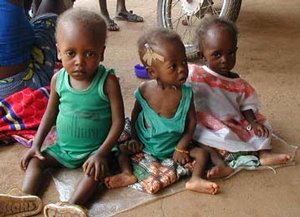 Last night I watched a video produced by the humanitarian agency MedAir which works in some of the most intense relief contexts in our world, establishing food distribution programs, collaborating with communities to create clean water sources, and rebuilding houses after natural disaster destroys whole communities. It doesn't matter how many times I see pictures of starving children wasting away, their gaunt faces haunt me and my heart is broken again. How is it possible that we allow children created in the image of God to endure such unimaginable horror?
 In the background of the video, Israeli recording artist Noa's song "We" provoked a feeling of grief within me that our common humanity is lost on us much of the time, as we forget that, in her words,
"we’re born/we’re cryinguntil then, there is no we.
we fall/we’re trying
we’re little/we’re laughing
we’re lonely sometimes
we grow/we’re open
we’re lost/we’re hoping
we’re careful/we’re calling
we’re leaving behind
you say we need to work together
with love and care for everyone
without the fighting and the anger
you say the world could be as one
but every time that you say we
do you think about me?
‘cause every time that you say we
i hope you think about me
we’re strong/we’re chosen
we’re scared/we’re frozen
we’re hardened/we’re hopeful
we’re holding at bay
we take/we’re giving
we shake/we’re living
we’re lovers/we’re sinners
we’re running away
and if we fail to make a difference
and if our hope is almost gone
despite the fighting and the anger
you say the world could be as one
but every time that you say we
do you think about me?
‘cause every time that you say we
i hope you think about me"
Subscribe to:
Posts (Atom)

